
puerto chale
baja
california sur

BAHÍA MAGDALENA
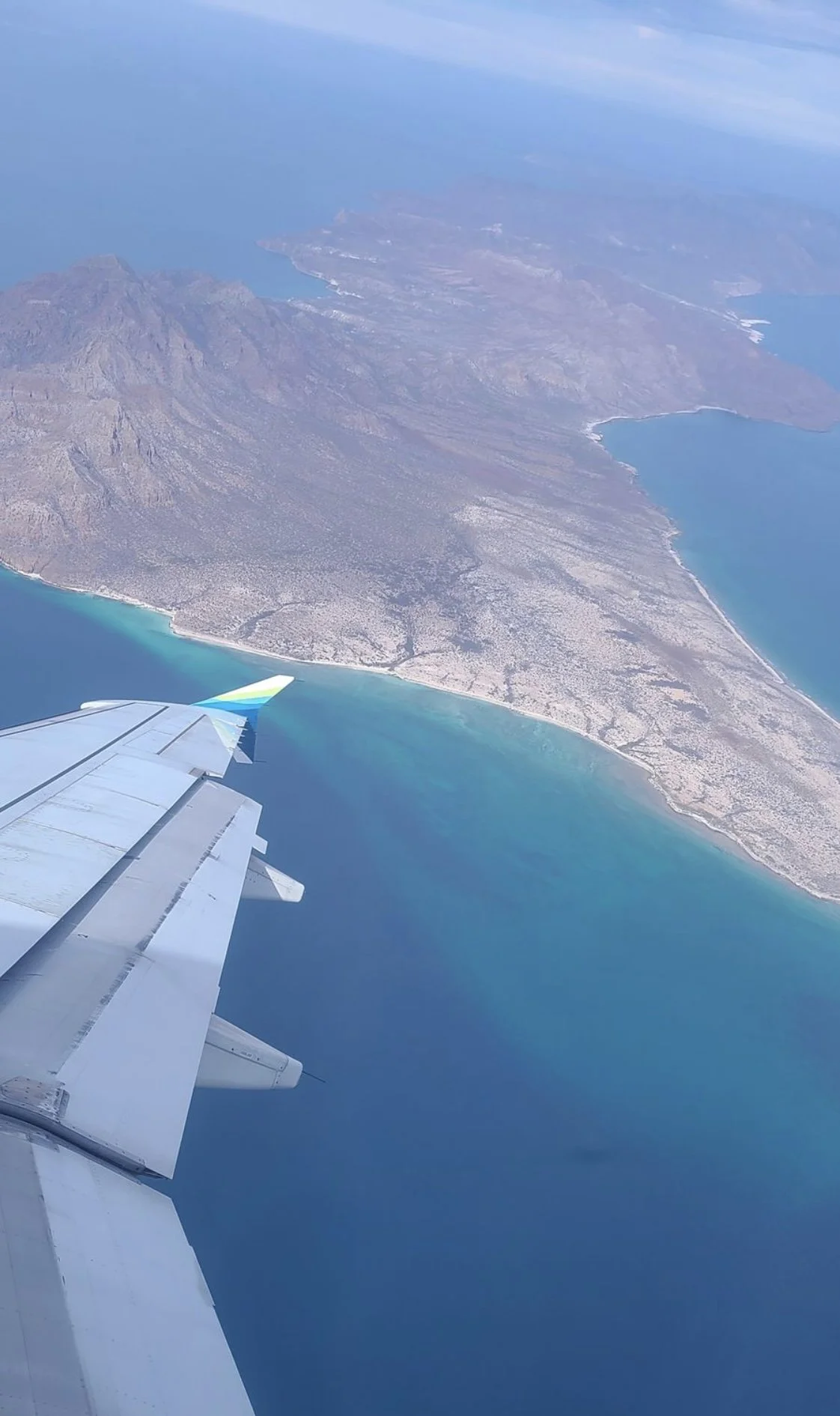
A large, protected lagoon system whose largest and central feature is the bay itself, that is comprised of mangrove lined channels, estuaries and dynamic dunes. This tiny fishing village on Baja California Sur’s Pacific coast is known for it’s richly vast biodiversity.
Surrounding barrier islands, like Isla Magdalena and Isla Santa Margarita, shield this bay from the open ocean. With the sandy landscape constantly shifting, inlets form between the barriers (the Pacific coast, islands) called “Bocas”.
What happens when the volume of an ocean is pushing through these natural, narrow inlets?
Strong currents bring incredible numbers of baitfish through this zone, where hungry predators happily line up to help themselves.
-
Our target species is Striped Marlin. Thanks to the area’s vast baitfish migration, our time during this fishery’s prime window brings a convergence of other trophy apex predator species for anglers to get after.
Found in Mag Bay on any given day:
OFFSHORE:
Striped Marlin: So much to share about this ELECTRIFYING environmental feat that they need their own section. See the separate “TARGETING STRIPED MARLIN” section below.
Dorado (Mahi Mahi): Abundant numbers of huge fish track the warm water temp breaks and feed alongside our main target species.
Yellowfin Tuna: Highly active schools hang along the thermal edges offshore, aggressively crashing on the surface as they feed.
Sailfish: Super fast (up to 70 mph!) predatory fish with a dorsal fin that resembles a, well, sail. This species gives anglers an intense, acrobatic, luminescent fight, albeit not quite equal to what you’ll experience when you hook a Striped Marlin.
Blue Marlin: With a rounder and more robust shape than the laterally compressed Striped Marlin, these fish tend to be larger than our target species, but it’s more like finding a needle in a haystack. More common in the waters surrounding the Atlantic Ocean, they’re also South of Mag Bay, holding in Cabo’s deep-water canyons along the steep underwater shelf. They’ll hone in to target their prey and often a chase will ensue.
Wahoo: Patrolling the deep drop-offs and underwater ridges just outside of the bay.
INSHORE:
Roosterfish: Grandes like to track schools of mullet and sardines RIGHT UP TO THE BEACH, bait spraying throughout! You’ll find them en route in the shallow shore break near the beach.
Yellowtail: Larger fish move onto warmer pockets like nearshore reefs and high spots as the Pacific Ocean starts to cool.
Jack Crevalle: Packs of super aggressive, rod-bending jacks patrol the waters nearshore, cornering bait against the sand.
MANGROVE ESTUARIES:
Black Snook: Legendary sized fish found hiding deep down in the root systems of the mangroves.
Broomtail & Leopard Grouper (Cabrilla): They pull HARD, and like to stack up against underwater ledges along the mangrove edges.
Orange-Mouth Corvina: A trophy species that loves to SMASH soft plastics, topwaters and flies in the channels.
Mangrove Snapper: Offer incredible sight-fishing in the backwater systems.
Anglers enjoy an endless mix of inshore and offshore fishing opportunities here in Mag Bay!
Check out our PUERTO CHALE, MAGDALENA BAY, BAJA BROCHURE for more details.
For current availability, visit our TRIP CALENDAR.
-
SO HOW BIG IS BIG?
You’ll find plenty of average 100-150 pound, 6-9 feet long Striped Marlin in Mag Bay. Trophy sized fish in this zone can exceed 200 to a whopping 400 pounds and grow as long as 13 feet!!!!
SIZE:
Striped Marlin aren’t just one of the fastest fish in the ocean, they’re also one of our ocean’s fastest-growing bony fish! Hatching at a mere 1/8th-2/10th of a SINGLE INCH, they can grow to MORE THAN THREE FEET LONG in their FIRSTFOUR MONTHS OF LIFE.
Can you imagine if our offspring were capable of growing at such a rapid pace?
HOW DO THEY DO IT?
Female Striped Marlin release massive quantities of eggs in a total of 40+ batches, one batch released every few days during the summer months. Eggs are released INDVIDUALLY, directly into the water along the upper, sunlit layers of the water column, ready to be fertilized by any number of the males in their wake. This reproductive form is called “Broadcast Spawning”, and allows the ocean currents to disperse these suspended eggs once fertilized.
A single female produces up to 120 million eggs each spawning season. This form of reproduction leads this typically solitary species in and around Mag Bay to group together in schools in order to ensure their success.
LIFESPAN:
Research has shown that under only the most ideal of conditions, these fish can live up to 20 years! Averaging just 10-12 years, theirs is a relatively short lifespan for billfish species, in particular. For comparison, Blue Marlin have a 30 year average lifespan - MORE THAN DOUBLE that of Striped Marlin! Recent studies have shown that females live longer than males so that they can fulfill multiple later-in-life spawning events.
This relatively short lifespan means that unlike other billfish, Striped Marlin reach sexual maturity very quickly - in just 1 to 3 years.
THE APEX PREDATOR:
Bahía Magdalena is home to the world’s largest concentrated migration and gathering of Striped Marlin. The annual Mexican Sardine Run (October-December, see “When We Go” section below for more info) draws baitfish schools the size of football fields.
This converges into Striped Marlin being an unobstructed, apex predator in such an extreme concentration unlike you’ll find anywhere else, ever.
Anglers regularly report seeing hundreds - sometimes even THOUSANDS - Striped Marlin IN A SINGLE DAY!! Contributing to this location’s density is the species hunting methods. To an observer, Striped Marlin execute a system of hunting that appears to be meticulously coordinated.
While most species of billfish are strictly solitary hunters, these fish have highly advanced social awareness and implement a co-op style multi-species hunting strategy.
Striped Marlin work together, whether amongst themselves or other species of sea life to feed on massive schools of baitfish.
Allies include sea lions, pelagic predators like Mahi Mahi (Dorado) and Tuna, and even birds, such as Frigates and Pelicans, play their part.
Mahi Mahi (Dorado) and Tuna will form an outer barrier for the school of prey, keeping them balled up tight, patrolling from all sides.
California Sea Lions are a double-edged Striped Marlin bill of an aid…. As resource competitors, they’ll naturally aim to strike the same prey, and often are helping to keep the bait balled up. However, word of advice? Never trust a sea lion to not slide in at the last minute and disrupt a Marlin’s best laid plan of attack.
Species of birds assist on the surface by striking from above, leading terrified baitfish huddled closely together.
As angles, we’re just visitors and at the mercy of how it all comes together. You’ll often be competing right alongside these species, as you’re casting and hoping that it’s a Striped Marlin that takes your fly. And not the damn birds….
THE HUNT IS ON!
There are 3 main hunting characteristics that set this species apart from other billfish:
They BLOCK bait by surrounding a school of prey. Some fish will go and stay deep, while others begin zipping around the outside edge, forcing the baitfish into more and more concentrated balls. Other fish then work to force the bait ball up toward the surface, the most useful natural barrier.
They feed in SHIFTS. That’s right, Striped Marlin are patient, and wait their turn at a series of coordinated, highly organized “stabs”. Rather than all that work to corral their food going to waste by all rushing in at once, they take turns using their bill to injure and stun their prey.
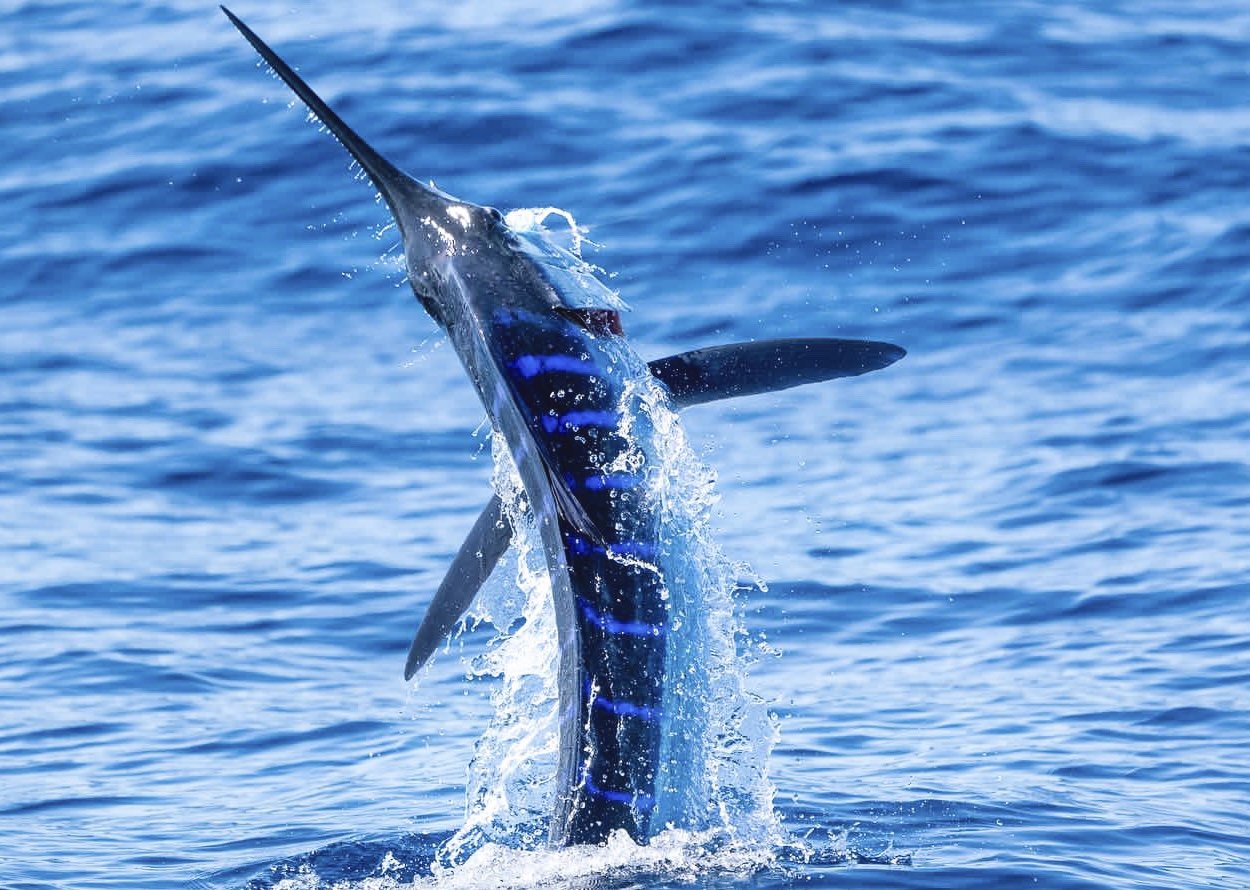
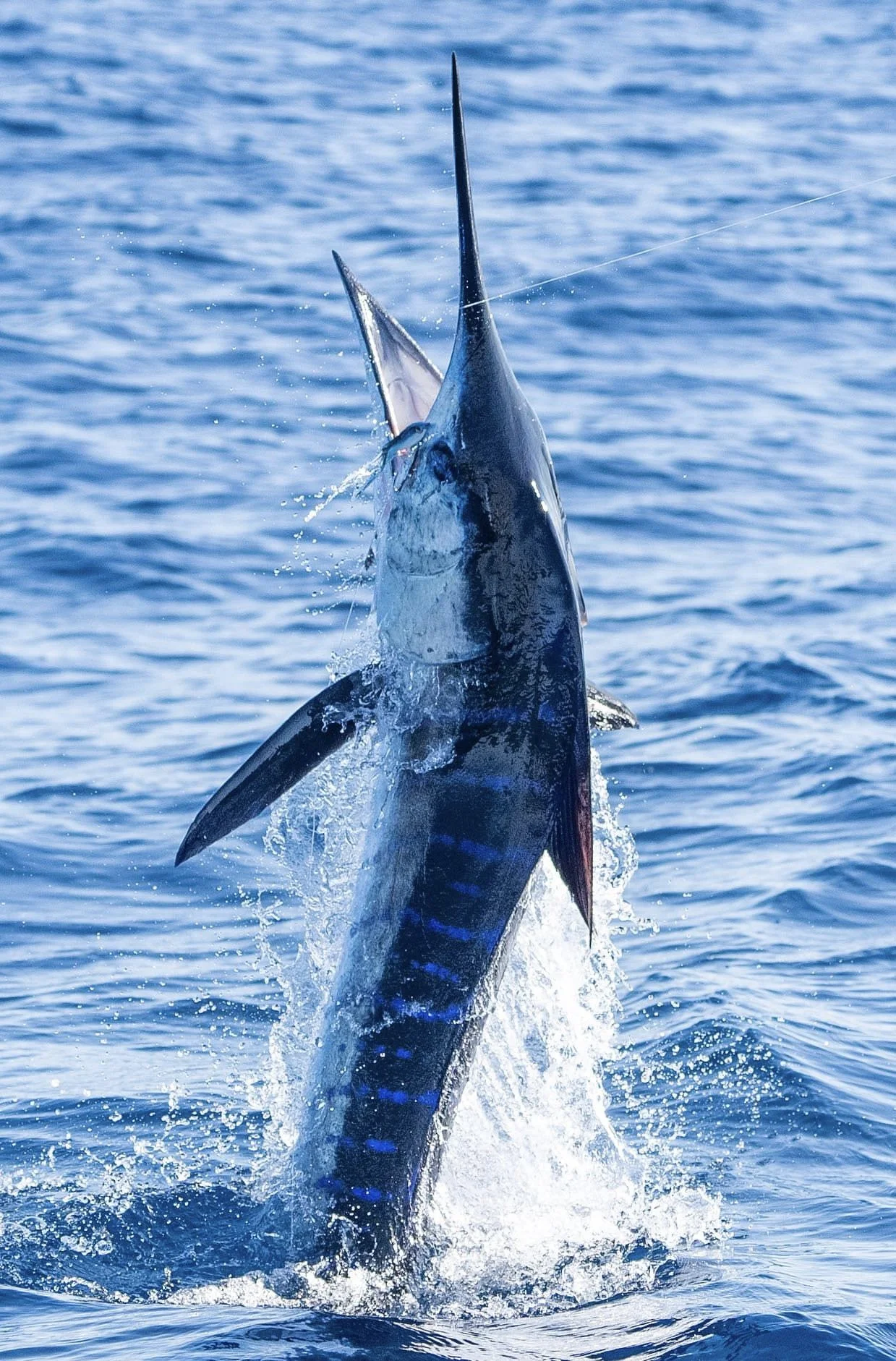
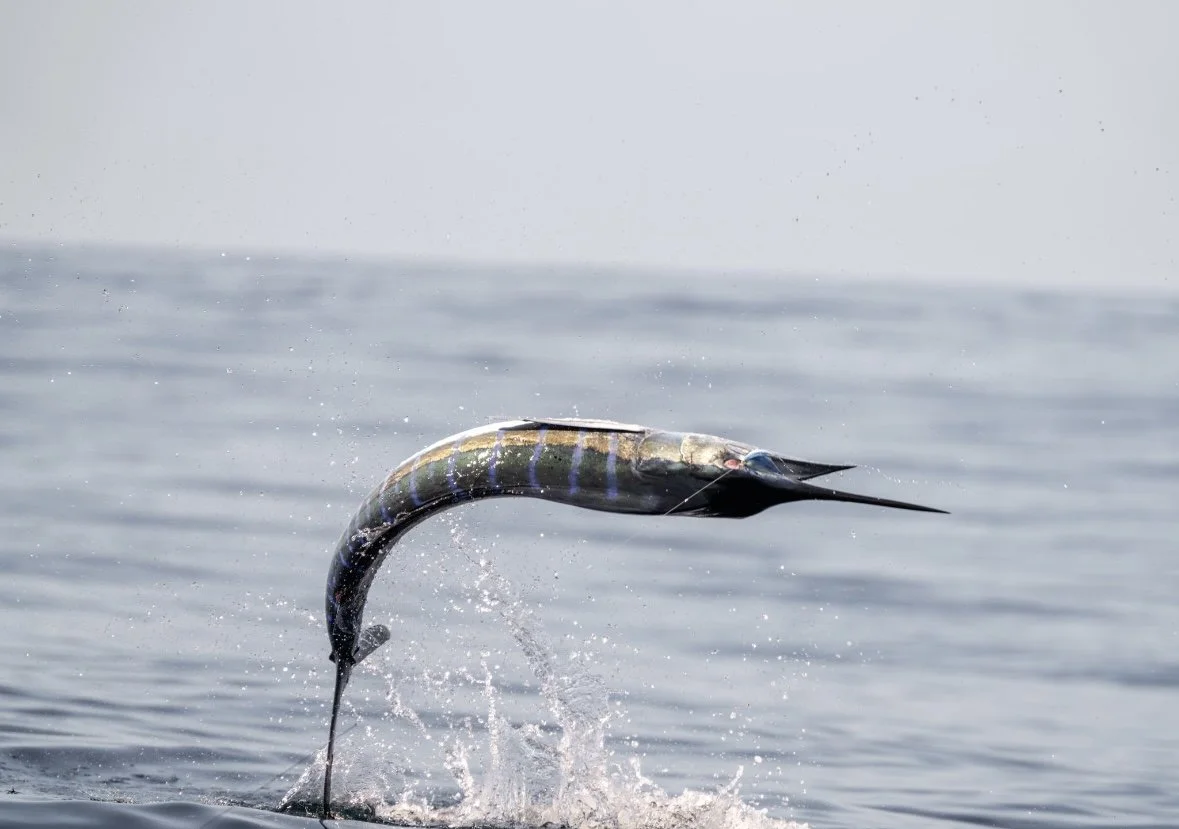
They LIGHT UP - LITERALLY!! Researchers discovered that Striped Marlin actually electrify their blue stripes to warn of their impending high-speed rushes at prey like a dynamic sequence of traffic lights. They “turn their lights on” about 10 seconds before initiating their charge.
MAX BRIGHTNESS = “It’s MY turn!” They’re gonna charge!
Lights OFF = Helper fish
The intensity is less important than the speed at which this contrast takes place. While we refer to them as “lighting up”, these billfish aren’t actually flipping an internal switch.
Instead, what warns other fish (and us!) of where the group is at in their feeding pattern is the SUDDEN SHIFT from their skin’s resting color (almost camo colored gray/blue - like a shark) to distinctly excited and vivid shades of cobalt blue and neon purple.
Anytime these fish get a rush of adrenaline, they are LIT UP with rapid flashes of intensely neon blue, purple, and teal. While other billfish like Sailfish and Blue Marlin also light up when they get excited, none come close to the electrifying aerial acrobatics that eclipse with Striped Marlin. The intensity, performance and layout of their “light show” is unrivaled by any other species on the planet, making them an essential bucket list fish.
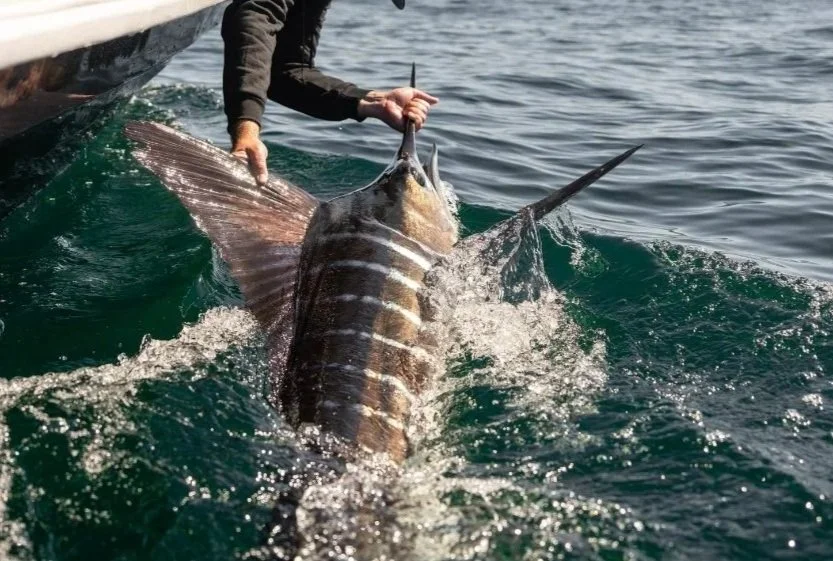
It’s incredible to experience, and difficult to put into words. They’re a unique species in many ways. Their 15-20 (always) stripes are the widest, most bold and prominent of any billfish. When they illuminate, they flash from head to tail with the highest contrast nature seems to allow!
Join us on this incredible adventure and discover Bahía Magdalena for yourself!!
For more specifics on our Puerto Chale program, check out our WEB BROCHURE.
Visit our TRIP CALENDAR for current availability.
-
We’re partnered with Captain Juan Lucero, widely known for his East Cape Roosterfish guide operation. When he wanted to create a new experience for anglers in Mag Bay, he turned to us. We’ve tapped a local Captain and his crew to join the team.
Each boat will have a member of each crew on board every day, ensuring anglers have as much support on the water as they deserve!
While a 12 wt may seem “heavy” to most seasoned freshwater anglers, in the world of fly billfishing, it’s light. So. . . . Why?!
Bahía Magdalena is such a unique fishery that the lighter tackle approach is not only more thrilling, it’s also extremely beneficial for a few reasons:
Match the Hatch: To get a Striped Marlin to eat your fly, you need to present it like a fleeing baitfish that broke off from the carefully contained bait ball. Rather than strapping into heavy, conventional “jig-sticks” with 100-pound braid, that makes a real splash on the surface with each cast, fly anglers can present their fly much more like the real deal.
Move Quick: This is an incredibly dynamic fishery that seems to move lightning fast. Fly anglers can move quickly to reset and cast again, hoping to land their fly in the “danger zone” before a bait ball moves on.
The Sport: Striped Marlin actually have a very short lifespan compared to other billfish species, just 10-12 years. They grow rapidly, as well. This means that while the average Striped Marlin hooked in Mag Bay is 80-125 pounds, they’re youthful and FIERY! We want to do our part to ensure that anglers have the ability to return and continue enjoying this unique fishery.
THE SETUP
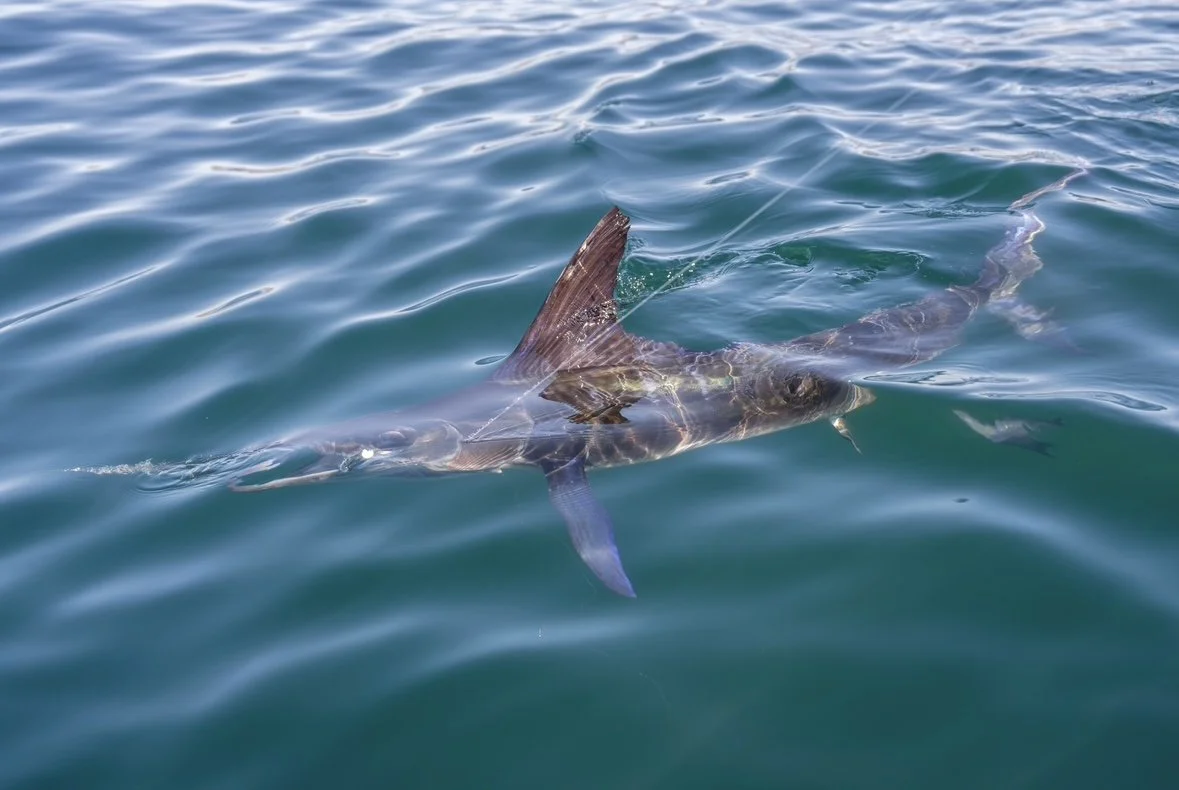
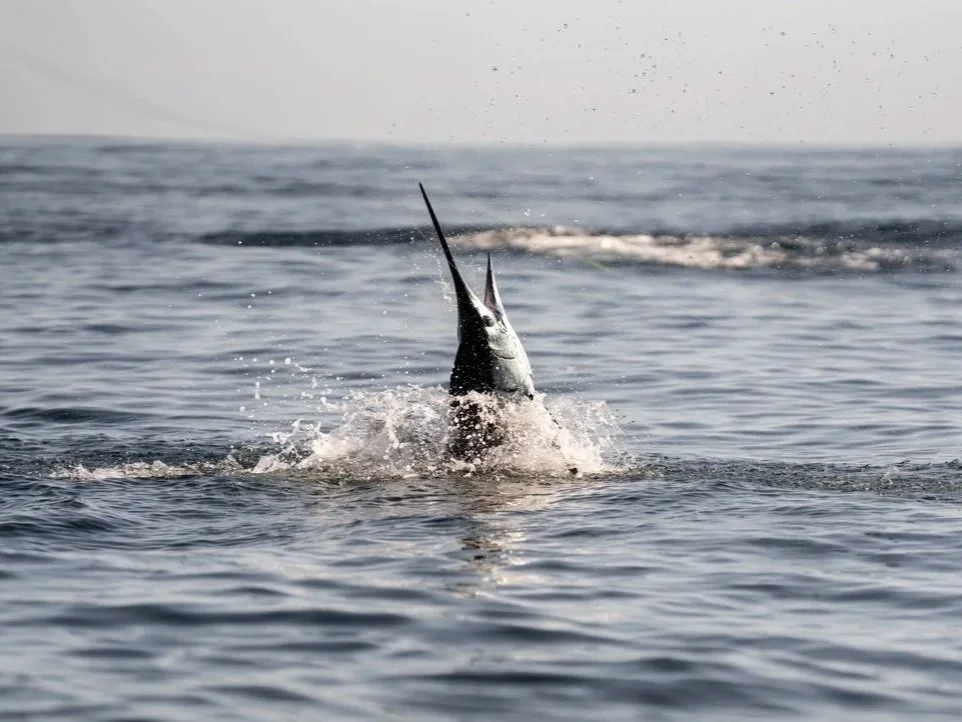
Your Captain navigates the Panga right up to these rolling bait balls. A Striped Marlin appears, close enough to the surface that you can even see it - slashing their bill side to side at insane speeds. They don’t impale prey, they slash, stun, and spook it right where they want it. Taking turns to light up and strike, Striped Marlin will make a pass to incapacitate their prey, then come back for a second pass, to collect, and eat it.
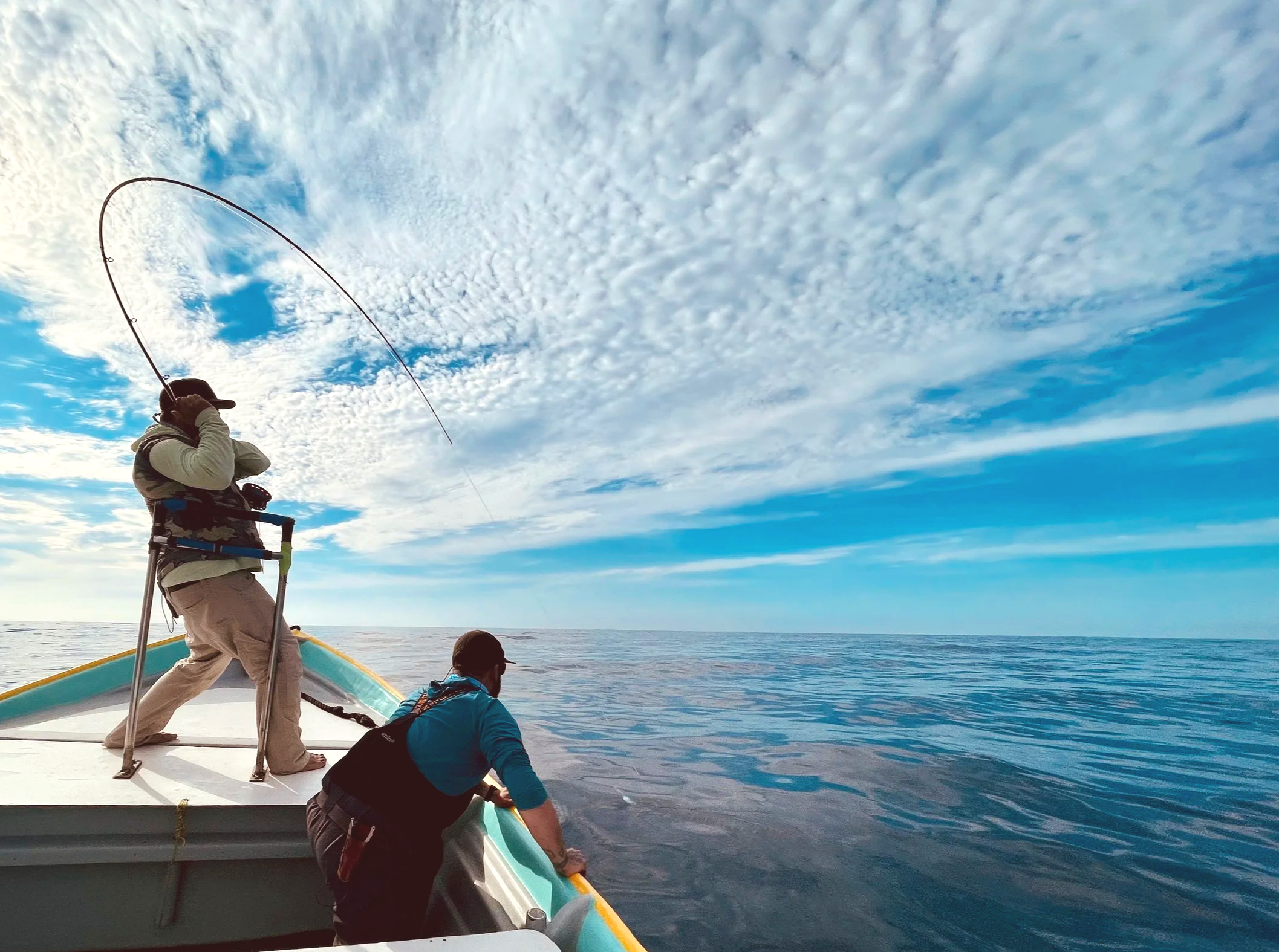
Your guide yells, “CAAASSSSTTTT!”, and pulls the teaser as your short, accurate cast lands. The Striped Marlin pivots instantly, charges your fly, and WHOMP!! Violently inhales your fly.
No time to think, just act!
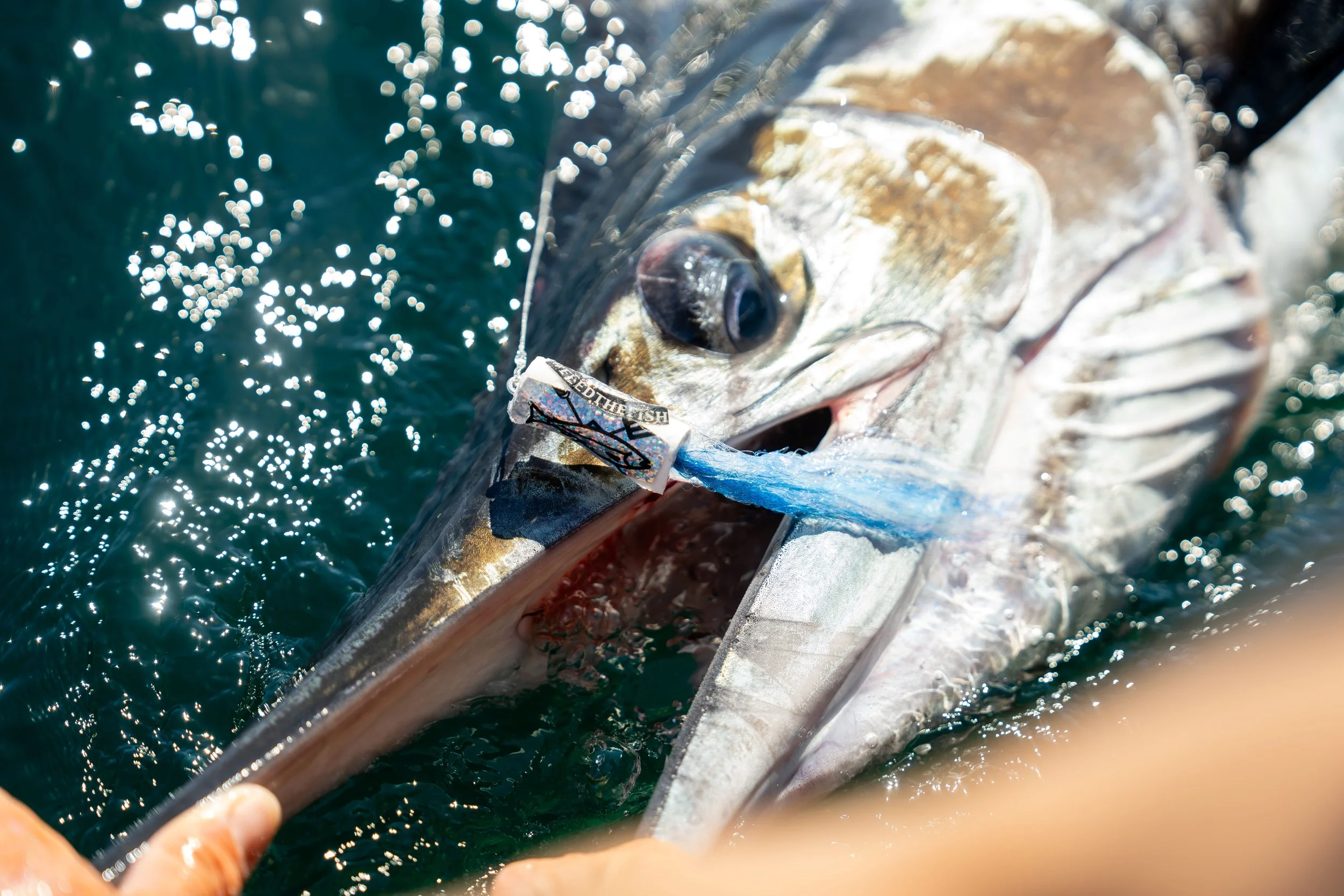
Strip-set firmly, DON’T LIFT YOUR ROD! Lifting your rod to set a 100+ pound Striped Marlin is. . . . Not going to end well for your rod, or you. Lifting a relatively small hook (6/0-8/0) to make it set on a Striped Marlin’s thin, bony jaw is an awful lot harder to accomplish than it is to yank the (barbless, non-stainless steel) hook right out of their mouth.
You’ve successfully strip-set the hook! Suddenly, the water a mere handful of feet from the boat just EXPLODES!
Everyone within sight will share in the dramatic experience, but NO PRESSURE! Just focus!
Hook a Striped Marlin on a 12 wt fly rod and without a doubt, you’re going to be hit with an INTENSE surge of adrenaline, only rivaled by that of THE FISH!
Theirs will be on full display as they illuminate, flashing bright, neon shades of blue and purple between gray and silver.
Join us for this high-energy, sight-casting on-the-water HUNT for Striped Marlin as they chase hyperactive bait balls in Baja California Sur’s Bahía Magdalena!
Check out our PUERTO CHALE, MAGDALENA BAY, BAJA BROCHURE for more details.
For current availability, visit our TRIP CALENDAR.
-
NOVEMBER:
Without a doubt, we have chosen to embark on this adventure during the penultimate window for targeting Striped Marlin, as well as an abundant assortment of other species around.
Get ready for what can only be described as a “National Geographic” style feeding frenzy RIGHT AT THE SURFACE during this fishery’s season peak!!
Staggering numbers of baitfish truly BLANKET the offshore banks in tightly packed - and swiftly moving - bait balls. Coming off the summer months, cooling ocean temperatures lends to the annual Mexican Sardine Run. We’re fishing from wide-gunnel Panga’s which allow our crew to pull right up to an active bait ball where Striped Marlin (and other species) are feeding, allowing anglers opportunities to sight-cast directly into the frenzy!
Offshore waters getting too rough later in the day? No problem. We’ll just head into the protected channels and fish on!
There’s no place like Mag Bay, and there’s no better time to experience this fishery than when this prime convergence hits!!
Check out our PUERTO CHALE WEB BROCHURE for more details.
For current availability, visit our Trip Calendar.
-
Puerto Chale is a tiny, remote fishing village on the Pacific side of the Baja California Sur Peninsula. In recent years, this zone has grown in popularity as a prime ecotourism destination. Known for being the southernmost gray whale nursery in Baja, where each winter, hundreds of migrating whales and their calves rest and feed.
We’re targeting the peak window when Striped Marlin are drawn in and around the bay as they follow the MASSIVE migration of baitfish. The annual Mexican Sardine Run continues into December, before tapering to a close in early January. As the weather drops to an average high of (just. . . .) 78-83°, the water temps continue to cool leading the baitfish to continue migrating south.
Temps during our prime Striped Marlin window are a little higher, averaging 84-88° most days, and cooling down to 60-65° at night. That means mornings will be chilly on the boat ride out to the Striped Marlin feeding grounds. But don’t worry! We’ve managed to cut the typical LONG BOAT RIDE that you’ll experience with most operations around Mag Bay.
It’s not a matter of better or worse, there are excellent outfitters running programs in this incredible fishery. We’re grateful for each day that we get out on the water, witnessing one of our ocean’s most electrifying feats.
So what’s different?
Where we launch: We’re launching in Puerto Chale.
Distance to Striped Marlin feeding grounds: 20-40 miles offshore.
Total time spent shuttling to/from the feeding grounds: Operations that load anglers onto Panga’s in Puerto Adolfo Lopez Mateos and Puerto San Carlos have a 15 minute or less car ride that accompanies a 1.5-2 hour boat ride.
We run pop-up style programs that allow us to learn, adapt, and perfect our programs long before we ever bring our first set of clients out. We’ve chosen to meet our captains and guides in Puerto Chale, where we load anglers and gear onto wide-gunnel Panga’s.
We’ll take a 40 minute van ride, that accompanies a boat ride that averages just 30-40 minutes!!! While all days are never equal in saltwater fly fishing, it can often be described as an arduous journey for anglers needing to stay upright in a fiberglass Panga as it crests 3-6 foot waves.
We’re fishing on the Pacific side of the Baja Peninsula, where the ocean is at the mercy of the winds. On rougher days, a really long round trip could severely limit your time spent chasing fish!
While you don’t need to be an adrenaline junky to endure Mag Bay, this fishery is not for the weary. Be prepared for some of, if not THE most intense and mind-bending fly fishing possible. This is truly a location that anglers will need to commit to, but once you do, well, you’ll leave already planning your inevitable return.
Check out our PUERTO CHALE, MAGDALENA BAY, BAJA BROCHURE for more details.
For current availability, visit our TRIP CALENDAR.
(707)495-7784
hospitality@travelcreel.com
-
Our target species is Striped Marlin. Thanks to the area’s vast baitfish migration, our time during this fishery’s prime window brings a convergence of other trophy apex predator species for anglers to get after.
Found in Mag Bay on any given day:
OFFSHORE:
Striped Marlin: So much to share about this ELECTRIFYING environmental feat that they need their own section. See the separate “TARGETING STRIPED MARLIN” section below.
Dorado (Mahi Mahi): Abundant numbers of huge fish track the warm water temp breaks and feed alongside our main target species.
Yellowfin Tuna: Highly active schools hang along the thermal edges offshore, aggressively crashing on the surface as they feed.
Sailfish: Super fast (up to 70 mph!) predatory fish with a dorsal fin that resembles a, well, sail. This species gives anglers an intense, acrobatic, luminescent fight, albeit not quite equal to what you’ll experience when you hook a Striped Marlin.
Blue Marlin: With a rounder and more robust shape than the laterally compressed Striped Marlin, these fish tend to be larger than our target species, but it’s more like finding a needle in a haystack. More common in the waters surrounding the Atlantic Ocean, they’re also South of Mag Bay, holding in Cabo’s deep-water canyons along the steep underwater shelf. They’ll hone in to target their prey and often a chase will ensue.
Wahoo: Patrolling the deep drop-offs and underwater ridges just outside of the bay.
INSHORE:
Roosterfish: Grandes like to track schools of mullet and sardines RIGHT UP TO THE BEACH, bait spraying throughout! You’ll find them en route in the shallow shore break near the beach.
Yellowtail: Larger fish move onto warmer pockets like nearshore reefs and high spots as the Pacific Ocean starts to cool.
Jack Crevalle: Packs of super aggressive, rod-bending jacks patrol the waters nearshore, cornering bait against the sand.
MANGROVE ESTUARIES:
Black Snook: Legendary sized fish found hiding deep down in the root systems of the mangroves.
Broomtail & Leopard Grouper (Cabrilla): They pull HARD, and like to stack up against underwater ledges along the mangrove edges.
Orange-Mouth Corvina: A trophy species that loves to SMASH soft plastics, topwaters and flies in the channels.
Mangrove Snapper: Offer incredible sight-fishing in the backwater systems.
Anglers enjoy an endless mix of inshore and offshore fishing opportunities here in Mag Bay!
Check out our PUERTO CHALE, MAGDALENA BAY, BAJA BROCHURE for more details.
For current availability, visit our TRIP CALENDAR.
-
SO HOW BIG IS BIG?
You’ll find plenty of average 100-150 pound, 6-9 feet long Striped Marlin in Mag Bay. Trophy sized fish in this zone can exceed 200 to a whopping 400 pounds and grow as long as 13 feet!!!!
SIZE:
Striped Marlin aren’t just one of the fastest fish in the ocean, they’re also one of our ocean’s fastest-growing bony fish! Hatching at a mere 1/8th-2/10th of a SINGLE INCH, they can grow to MORE THAN THREE FEET LONG in their FIRSTFOUR MONTHS OF LIFE.
Can you imagine if our offspring were capable of growing at such a rapid pace?
HOW DO THEY DO IT?
Female Striped Marlin release massive quantities of eggs in a total of 40+ batches, one batch released every few days during the summer months. Eggs are released INDVIDUALLY, directly into the water along the upper, sunlit layers of the water column, ready to be fertilized by any number of the males in their wake. This reproductive form is called “Broadcast Spawning”, and allows the ocean currents to disperse these suspended eggs once fertilized.
A single female produces up to 120 million eggs each spawning season. This form of reproduction leads this typically solitary species in and around Mag Bay to group together in schools in order to ensure their success.
LIFESPAN:
Research has shown that under only the most ideal of conditions, these fish can live up to 20 years! Averaging just 10-12 years, theirs is a relatively short lifespan for billfish species, in particular. For comparison, Blue Marlin have a 30 year average lifespan - MORE THAN DOUBLE that of Striped Marlin! Recent studies have shown that females live longer than males so that they can fulfill multiple later-in-life spawning events.
This relatively short lifespan means that unlike other billfish, Striped Marlin reach sexual maturity very quickly - in just 1 to 3 years.
THE APEX PREDATOR:
Bahía Magdalena is home to the world’s largest concentrated migration and gathering of Striped Marlin. The annual Mexican Sardine Run (October-December, see “When We Go” section below for more info) draws baitfish schools the size of football fields.
This converges into Striped Marlin being an unobstructed, apex predator in such an extreme concentration unlike you’ll find anywhere else, ever.
Anglers regularly report seeing hundreds - sometimes even THOUSANDS - Striped Marlin IN A SINGLE DAY!! Contributing to this location’s density is the species hunting methods. To an observer, Striped Marlin execute a system of hunting that appears to be meticulously coordinated.
While most species of billfish are strictly solitary hunters, these fish have highly advanced social awareness and implement a co-op style multi-species hunting strategy.
Striped Marlin work together, whether amongst themselves or other species of sea life to feed on massive schools of baitfish.
Allies include sea lions, pelagic predators like Mahi Mahi (Dorado) and Tuna, and even birds, such as Frigates and Pelicans, play their part.
Mahi Mahi (Dorado) and Tuna will form an outer barrier for the school of prey, keeping them balled up tight, patrolling from all sides.
California Sea Lions are a double-edged Striped Marlin bill of an aid…. As resource competitors, they’ll naturally aim to strike the same prey, and often are helping to keep the bait balled up. However, word of advice? Never trust a sea lion to not slide in at the last minute and disrupt a Marlin’s best laid plan of attack.
Species of birds assist on the surface by striking from above, leading terrified baitfish huddled closely together.
As angles, we’re just visitors and at the mercy of how it all comes together. You’ll often be competing right alongside these species, as you’re casting and hoping that it’s a Striped Marlin that takes your fly. And not the damn birds….
THE HUNT IS ON!
There are 3 main hunting characteristics that set this species apart from other billfish:
They BLOCK bait by surrounding a school of prey. Some fish will go and stay deep, while others begin zipping around the outside edge, forcing the baitfish into more and more concentrated balls. Other fish then work to force the bait ball up toward the surface, the most useful natural barrier.
They feed in SHIFTS. That’s right, Striped Marlin are patient, and wait their turn at a series of coordinated, highly organized “stabs”. Rather than all that work to corral their food going to waste by all rushing in at once, they take turns using their bill to injure and stun their prey.
They LIGHT UP - LITERALLY!! Researchers discovered that Striped Marlin actually electrify their blue stripes to warn of their impending high-speed rushes at prey like a dynamic sequence of traffic lights. They “turn their lights on” about 10 seconds before initiating their charge.
MAX BRIGHTNESS = “It’s MY turn!” They’re gonna charge!
Lights OFF = Helper fish
The intensity is less important than the speed at which this contrast takes place. While we refer to them as “lighting up”, these billfish aren’t actually flipping an internal switch.
Instead, what warns other fish (and us!) of where the group is at in their feeding pattern is the SUDDEN SHIFT from their skin’s resting color (almost camo colored gray/blue - like a shark) to distinctly excited and vivid shades of cobalt blue and neon purple.
Anytime these fish get a rush of adrenaline, they are LIT UP with rapid flashes of intensely neon blue, purple, and teal. While other billfish like Sailfish and Blue Marlin also light up when they get excited, none come close to the electrifying aerial acrobatics that eclipse with Striped Marlin. The intensity, performance and layout of their “light show” is unrivaled by any other species on the planet, making them an essential bucket list fish.
It’s incredible to experience, and difficult to put into words. They’re a unique species in many ways. Their 15-20 (always) stripes are the widest, most bold and prominent of any billfish. When they illuminate, they flash from head to tail with the highest contrast nature seems to allow!
Join us on this incredible adventure and discover Bahía Magdalena for yourself!!
For more specifics on our Puerto Chale program, check out our WEB BROCHURE.
Visit our TRIP CALENDAR for current availability.
-
We’re partnered with Captain Juan Lucero, widely known for his East Cape Roosterfish guide operation. When he wanted to create a new experience for anglers in Mag Bay, he turned to us. We’ve tapped a local Captain and his crew to join the team.
Each boat will have a member of each crew on board every day, ensuring anglers have as much support on the water as they deserve!
While a 12 wt may seem “heavy” to most seasoned freshwater anglers, in the world of fly billfishing, it’s light. So. . . . Why?!
Bahía Magdalena is such a unique fishery that the lighter tackle approach is not only more thrilling, it’s also extremely beneficial for a few reasons:
Match the Hatch: To get a Striped Marlin to eat your fly, you need to present it like a fleeing baitfish that broke off from the carefully contained bait ball. Rather than strapping into heavy, conventional “jig-sticks” with 100-pound braid, that makes a real splash on the surface with each cast, fly anglers can present their fly much more like the real deal.
Move Quick: This is an incredibly dynamic fishery that seems to move lightning fast. Fly anglers can move quickly to reset and cast again, hoping to land their fly in the “danger zone” before a bait ball moves on.
The Sport: Striped Marlin actually have a very short lifespan compared to other billfish species, just 10-12 years. They grow rapidly, as well. This means that while the average Striped Marlin hooked in Mag Bay is 80-125 pounds, they’re youthful and FIERY! We want to do our part to ensure that anglers have the ability to return and continue enjoying this unique fishery.
THE SETUP
Your Captain navigates the Panga right up to these rolling bait balls. A Striped Marlin appears, close enough to the surface that you can even see it - slashing their bill side to side at insane speeds. They don’t impale prey, they slash, stun, and spook it right where they want it. Taking turns to light up and strike, Striped Marlin will make a pass to incapacitate their prey, then come back for a second pass, to collect, and eat it.
Your guide yells, “CAAASSSSTTTT!”, and pulls the teaser as your short, accurate cast lands. The Striped Marlin pivots instantly, charges your fly, and WHOMP!! Violently inhales your fly.
No time to think, just act!
Strip-set firmly, DON’T LIFT YOUR ROD! Lifting your rod to set a 100+ pound Striped Marlin is. . . . Not going to end well for your rod, or you. Lifting a relatively small hook (6/0-8/0) to make it set on a Striped Marlin’s thin, bony jaw is an awful lot harder to accomplish than it is to yank the (barbless, non-stainless steel) hook right out of their mouth.
You’ve successfully strip-set the hook! Suddenly, the water a mere handful of feet from the boat just EXPLODES!
Everyone within sight will share in the dramatic experience, but NO PRESSURE! Just focus!
Hook a Striped Marlin on a 12 wt fly rod and without a doubt, you’re going to be hit with an INTENSE surge of adrenaline, only rivaled by that of THE FISH!
Theirs will be on full display as they illuminate, flashing bright, neon shades of blue and purple between gray and silver.
Join us for this high-energy, sight-casting on-the-water HUNT for Striped Marlin as they chase hyperactive bait balls in Baja California Sur’s Bahía Magdalena!
Check out our PUERTO CHALE, MAGDALENA BAY, BAJA BROCHURE for more details.
For current availability, visit our TRIP CALENDAR.
-
NOVEMBER:
Without a doubt, we have chosen to embark on this adventure during the penultimate window for targeting Striped Marlin, as well as an abundant assortment of other species around.
Get ready for what can only be described as a “National Geographic” style feeding frenzy RIGHT AT THE SURFACE during this fishery’s season peak!!
Staggering numbers of baitfish truly BLANKET the offshore banks in tightly packed - and swiftly moving - bait balls. Coming off the summer months, cooling ocean temperatures lends to the annual Mexican Sardine Run. We’re fishing from wide-gunnel Panga’s which allow our crew to pull right up to an active bait ball where Striped Marlin (and other species) are feeding, allowing anglers opportunities to sight-cast directly into the frenzy!
Offshore waters getting too rough later in the day? No problem. We’ll just head into the protected channels and fish on!
There’s no place like Mag Bay, and there’s no better time to experience this fishery than when this prime convergence hits!!
Check out our PUERTO CHALE WEB BROCHURE for more details.
For current availability, visit our Trip Calendar.
-
Puerto Chale is a tiny, remote fishing village on the Pacific side of the Baja California Sur Peninsula. In recent years, this zone has grown in popularity as a prime ecotourism destination. Known for being the southernmost gray whale nursery in Baja, where each winter, hundreds of migrating whales and their calves rest and feed.
We’re targeting the peak window when Striped Marlin are drawn in and around the bay as they follow the MASSIVE migration of baitfish. The annual Mexican Sardine Run continues into December, before tapering to a close in early January. As the weather drops to an average high of (just. . . .) 78-83°, the water temps continue to cool leading the baitfish to continue migrating south.
Temps during our prime Striped Marlin window are a little higher, averaging 84-88° most days, and cooling down to 60-65° at night. That means mornings will be chilly on the boat ride out to the Striped Marlin feeding grounds. But don’t worry! We’ve managed to cut the typical LONG BOAT RIDE that you’ll experience with most operations around Mag Bay.
It’s not a matter of better or worse, there are excellent outfitters running programs in this incredible fishery. We’re grateful for each day that we get out on the water, witnessing one of our ocean’s most electrifying feats.
So what’s different?
Where we launch: We’re launching in Puerto Chale.
Distance to Striped Marlin feeding grounds: 20-40 miles offshore.
Total time spent shuttling to/from the feeding grounds: Operations that load anglers onto Panga’s in Puerto Adolfo Lopez Mateos and Puerto San Carlos have a 15 minute or less car ride that accompanies a 1.5-2 hour boat ride.
We run pop-up style programs that allow us to learn, adapt, and perfect our programs long before we ever bring our first set of clients out. We’ve chosen to meet our captains and guides in Puerto Chale, where we load anglers and gear onto wide-gunnel Panga’s.
We’ll take a 40 minute van ride, that accompanies a boat ride that averages just 30-40 minutes!!! While all days are never equal in saltwater fly fishing, it can often be described as an arduous journey for anglers needing to stay upright in a fiberglass Panga as it crests 3-6 foot waves.
We’re fishing on the Pacific side of the Baja Peninsula, where the ocean is at the mercy of the winds. On rougher days, a really long round trip could severely limit your time spent chasing fish!
While you don’t need to be an adrenaline junky to endure Mag Bay, this fishery is not for the weary. Be prepared for some of, if not THE most intense and mind-bending fly fishing possible. This is truly a location that anglers will need to commit to, but once you do, well, you’ll leave already planning your inevitable return.
Check out our PUERTO CHALE, MAGDALENA BAY, BAJA BROCHURE for more details.
For current availability, visit our TRIP CALENDAR.